Support for your Response to the Key Stage 4 Performance Measures Consultation
Added to website 20/04/2026.
The government’s key stage 4 performance measures and targeted RISE extension consultation seeks views on proposals to improve key stage 4 academic performance measures and to extend school improvement support from the Department for Education’s targeted regional improvement for standards and excellence (RISE) service. This resource has been put together to help you complete the consultation, allowing you to share your views with the government on this important topic.
The government’s key stage 4 performance measures and targeted RISE extension consultation seeks views on proposals to improve key stage 4 academic performance measures and to extend school improvement support from the Department for Education’s targeted regional improvement for standards and excellence (RISE) service. The consultation closes on 4th May 2026. The first section of the consultation seeks views on what they propose to change for Progress 8 (a key performance measure for schools). The latter section focusses on the Department for Education’s (DfE) targeted regional improvement for standards and excellence (RISE) teams.
This is an opportunity to give your views on:
- improving Progress 8 and Attainment 8 measures through a refreshed Progress 8 curriculum model
- a better way to recognise the progress of pupils with low prior attainment as part of improvements to the wider suite of additional performance measures
- extending targeted RISE support to primary and secondary schools with low achievement
This resource has been put together to help you complete the consultation, allowing you to share your views with the government on this important topic. We know that you might not have the time or capacity to fully digest the consultation or the supporting information from the DfE, therefore, Music Mark’s Schools Lead Abi Marrison created this guide which summarises the chapters, proposals and questions in the consultation. Below, you will find each question in the consultation, alongside suggested responses depending on whether your views are in support of or against the proposal in each question.
Who should complete the consultation?
The consultation questions relating to key stage 4 performance measures, known as Progress 8, can be completed by anyone with a vested interest in education. It is useful for teachers and school leaders at all phases of education to have their say as it centres on what we measure in the school system. For those working directly with schools rather than in them it is an opportunity to take a wide view at the accountability measures and how these impact school decisions on provision of resource, budget, teacher specialism and qualification options.
Where can I complete the consultation survey?
When you are ready, you can complete the consultation survey survey here.
What is in Chapter 1?
Chapter 1, titled Improving Progress 8 and Attainment 8 Measures, sets out proposals to refresh the Progress 8 model. You will encounter mention of ‘buckets’ and ‘slots’; these are where subjects have been grouped together into compulsory and optional choices. The reason it is called Progress 8 is that there are 8 slots, as numbered in the image below.
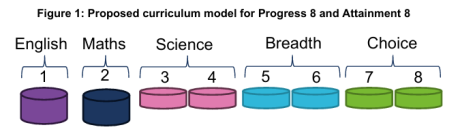
Have time for further reading? Read pages 9 – 14 of the guide from the DfE.
What are the proposals?
- Continue Progress 8 based on pupil performance in 8 qualifications (8 slots)
- Add a new fourth category for the breadth slots (5 or 6). See question 12.
- Include technical or vocational awards in the breadth and choice options (5 – 8)
- A methodology change: ranking schools in order of progress score and assigning bandings based on percentiles
Question 11
How far do you agree that these changes to the Progress 8 model strike a better balance between breadth and flexibility compared with the current P8? Please explain your views.
Suggested Response
The change is a slight move. Music will always be in the breadth or choice slot. The concern remains that these progress measures have been adjusted, but still stress that English and Maths matter most, then science, then humanities, arts and sports. This hierarchy has not changed.
The changes to the Progress 8 model do not align enough with how Ofsted measures a school’s success across the evaluation areas, as they still prioritise and cement the weighting of English, Maths and Science above a broad and inclusive curriculum.
The removal of the English Baccalaureate (EBacc) was a significant move to broaden opportunities and access to a wider range of subjects for all children and young people. The Progress 8 model has not been significantly reformed to support the implementation of a refreshed national curriculum and to align with the Department for Education’s mission on SEND reform and protecting a rich education that includes music, sport, art, and wider learning.
If Ofsted is measuring a well-rounded education that promotes citizenship, wellbeing, belonging, and inclusion, then Progress 8 also needs to go beyond looking at qualification outcomes in 8 subjects, whatever their composition.
Question 12
What are your views on the inclusion of a fourth category (science) for breadth slots 5 and 6? [Support inclusion of a fourth category / Do not support inclusion of a fourth category / Unsure].
Breadth slots 5 and 6 must be filled by GCSEs from these categories:
- Category A – humanities – geography, history, religious studies
- Category B – creative – art and design, music, drama, dance, design and technology Category C – languages – modern foreign languages and ancient languages
Should an additional category be included?
- Category D – 3rd science – computer science – design & technology
Suggested Responses
In support of:
The aim is to provide choice and a rich, broad curriculum.
Having science, D&T, and computer science added as a category for a breadth slot gives student choice, and schools still need to provide humanities, creative and languages options for the remaining breadth and choice slots.
Though their studies will be less broad, there is opportunity for a humanity, creative subject and language, and they can still opt for two creative subjects should they choose.
Do not support:
The inclusion of Science as a 4th category could restrict the uptake of creative subjects. Science, English, and Maths teaching roles will be more stable, and this may affect teachers’ training in other subjects and the workforce delivering music.
Unsure:
The caveat is there has to be the provision available, schools need to highlight the benefits as to why a student focussing on science should also study art or music.
Question 13
Do you agree that Progress 8 should allow technical awards in the breadth and choice slots, with a maximum of two across all slots? [Strongly agree / Agree / Neutral / Disagree / Strongly disagree]
Please explain your views. [Free text– limit of 3000 characters]
Suggested Responses
In support of:
Technical awards being available and counting towards the accountability measure should support young people with clear interests, such as music technology. If technical awards count in breadth and choice slots, they give students access to different qualification paths.
However, the technical awards may want to be broken down into categories (or slots), as GCSEs are, to give parity across subjects and teacher specialisms.
The change to include technical awards could help lower-attaining students fill all of the Progress 8 slots.
Do not support:
A consequence may be that GCSEs are taken in English, Maths, and Sciences, and technical awards become more popular than GCSEs in creative subjects such as music, further creating the perception that they are not rigorous or valuable. This may continue the decline in uptake of GCSE music, which will have a knock-on effect on further and higher education and pathways into academic study of creative subjects.
Question 14
Do you have any comments on the minor methodological adjustment? [Free text – limit of 3000 characters]
The methodological change is ranking schools in order of progress score and assigning bandings based on percentiles in line with national averages. There is further explanation on ‘confidence intervals’ on page 13 of the guide.
Suggested Response
Ranking based on outcome data will always present one narrow picture of the school’s whole education of the child. The DfE have outlined that even with the proposals, there is uncertainty in what is presented.
The achievement evaluation area of the Ofsted inspection toolkit will interrogate and scrutinise this data against national averages, but this should be balanced with how all pupils, including those with SEND, are being provided for and enabled to progress.
Question 15
Do you have any other comments on the proposed changes? [Free text – limit of 3000 characters]
It is concerning, in a measure, that the baseline for school success is drawn from a narrow sample of what Primary education entails. The lack of focus in this consultation on the fact that Key Stage 2 Standardised Assessment Tests (SATs), comprise reading, writing and maths (spelling, punctuation and Grammar, (SPAG) has been removed) demonstrates a concerning lack of rhetoric around the importance of breadth.
These cumulative measures at the end of Primary school are not preparing young people to excel in their breadth and choice buckets, yet this has been the way Progress 8 has been measured.
It reinforces the message that the most valuable subjects are Math and English, rather than seeing them as connected parts.
About the Provider

Music Mark
We are a membership organisation, Subject Association, and an Arts Council England Investment Principles Support Organisation (IPSO) advocating for excellent musical learning in and out of school.