What does Benedict’s Law mean for music education?
2nd July 2026
Benedict’s Law: A guide for music education providers
Benedict’s Law is new statutory guidance aimed at helping improve allergy response and reduce deaths from anaphylactic shock. It comes into force in England in September 2026, and similar legislation is likely to follow in the other home nations. It is aimed at schools (including independent schools and state nurseries attached to schools but not private nurseries) and establishes new duties:
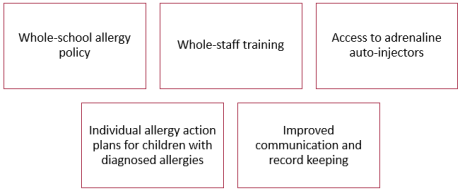
The statutory guidance is due by July 2026 and at the time of writing (late June) is not yet available. All the references available at this time refer to schools, so it is unclear how Benedict’s Law applies to the wider education ecosystem. Nevertheless, it points towards good practice that our sector will wish to consider.
Adrenalin auto-injectors (AAIs)
These are often referred to as EpiPens, although this is a brand name. Either EpiPen or Jext are suitable for schools. Note that there are two dosages available for patients below 30kg body weight (usually KS1) and above 30kg. They are bought in pairs and must be kept as pairs out of direct sunlight between 0°C and 25°C. They must not be kept in ordinary first aid kits. Someone will need to check them periodically to ensure they are in date and are still serviceable.
Schools will be required to hold at least two spare AAIs, but may need more to cover large sites or multiple sites, or if they require both sizes. They cost around £100 each, although Anaphylaxis UK suggests asking if the school can have NHS pricing. A letter from the school, signed by the headteacher is required as these are prescription medicines. It is not clear whether music services and other music education providers will be eligible to purchase AAIs.
Anyone with a diagnosis should have and carry AAIs for their own use. School stocks are not linked to any individual and they may be used on anyone who requires them, irrespective of diagnosis.
Training
There are multiple providers offering training which is (or will very soon be) compliant with Benedict’s Law. It may be possible to add it to existing first aid training but note that all school staff must be trained, whereas first aid training is usually only provided based on identified need. Face-to-face training may include using a ‘dummy’ AAI for confidence but they are designed to be easy to administer.
Some online training is compliant but is less likely to include practical experience.
Scenarios in music education
This paper will consider the various scenarios that music education (other than classroom lessons) is provided under. The proviso always stands that anyone with prescribed AAIs should carry two at all times.
In-school peripatetic lessons
It is unclear what (if anything) the statutory guidance will say in respect of external providers working in schools. The guidance currently available only talks about schools and school staff. We have already seen schools saying that they will require external providers to take full responsibility for pupils while in their care and so they will need suitable training.
Schools will have a duty to tell tutors if a child they teach carries an AAI. Students should bring their AAIs to their lesson and if they do not, they should be sent back to class for it.
It is important to say however that, even though the overall incidence of allergies may be rising in the general population, Benedict’s Law neither increases the probability of a child experiencing anaphylaxis during a peripatetic music lesson nor (in itself) really changes the tutor’s responsibility to respond. Peripatetic tutors will need to be equipped to deal with the immediate emergency and the school’s medical procedures should then take over.
Choirs, ensembles and clubs in schools
It is highly likely that external staff leading in-school activities out of school time will need to be able to comply with schools’ allergy policies and will need to be trained to recognise and respond to anaphylactic shock up to and including administering an AAI. Schools will need to communicate with the group leader if there is a child in the group with an AAI. Again, following any immediate emergency, the matter will be ‘handed back’ to school staff.
Music centres, ensembles, rehearsals and workshops
It is unlikely that these will be covered in the statutory guidance. Providers will need to make the best arrangements they reasonably can, for example agreeing access to venues’ AAIs. If music services are able to buy AAIs, they will probably need to provide at least one pair for every music centre.
Medical information for each group member will need to be updated and staff must be told about any members with AAIs. As in school, people with prescription AAIs should carry their own pair at all times.
Residential courses and tours
Anecdotally, and logically, the risk of anaphylaxis is much higher on courses and tours than other music education provision. Risk assessments should already be in place, along with medical declarations and your usual medicine controls.
For courses on school premises, the school’s AAIs may be made available but consider how you would access them outside of office hours. If spare AAIs can be obtained, these should be carried in a specific kit (not the first aid kit). If courses are on large sites or groups are accommodated in separate boarding houses, one kit may not be sufficient.
It is unlikely that you will be able to take spare AAIs abroad as they are prescription medicines.
Controlling for allergens
Providers should review their risk assessments and policies for allergen controls, e.g. nut-free environments.
Parental expectations
Parents and carers may simply assume that music education providers will act in the same way as schools. Parental communications about your provision may need to make it clear that you do not have the same right of access to AAIs.
Adults with AAIs
Benedict’s Law is aimed at improving outcomes for pupils in school and most guidance to date does not mention staff or other adults. If they have a diagnosis, they should carry their own AAIs at all times. Schools’ (or providers’) spare AAIs should be used on adults if needed: they are not exclusively for use with children.
Using mobile phones to call for help
Music Mark are aware of members updating their mobile phone policies to allow tutors in schools to use them to call for help (that is where mobiles are not left at Reception and there is a signal in the practice room). We would expect that in any emergency but particularly a life and death situation such as anaphylaxis, common sense would prevail on the part of the tutor, the provider and the school, regardless of the policy.
Actions for music education providers
- Plan to provide anaphylaxis training all staff who have contact with children, ideally in September
- Add confirmation of anaphylaxis training to letters of reassurance (if provided to schools)
- Assess the number of pairs of AAIs your organisation would require if able to purchase and identify sufficient budget
- Check statutory guidance on publication (expected July 2026)
- Communicate or publish your policy and plans for Benedict’s Law (schools, venues, parents)
- Identify staff who may need additional support or reassurance over their role
- Highlight employee assistance programmes in case people are stressed, anxious or triggered
- Consider updating your mobile phone use policy
Benedict’s Law does not change the underlying risks
It is important to say that, even though the overall incidence of allergies may be rising in the general population, Benedict’s Law neither increases the probability of anaphylaxis during music education activity nor (in itself) really changes the responsibility to respond.
Peripatetic tutors, music centre staff, ensemble tutors and tour staff already have to deal with learners’ medical needs as they arise, including emergencies. Anaphylaxis is an existing risk. It is generally higher for residential courses and tours and relatively low (but not zero) for non-residential music education activity.
Training will give staff more confidence and increase the chances of a positive outcome, should they be faced with someone in anaphylactic shock.
References
https://www.anaphylaxis.org.uk/education/benedicts-law/
https://allergycentre.co.uk/press/benedicts-law-is-now-law/
https://benedictblythe.com/benedicts-law/
This article is Subject to update in light of the publication of statutory guidance expected July 2026
For further news updates from across the Music Education sector, visit our News page