Twinkl launch whole-class beginner instrumental units
26th October 2026
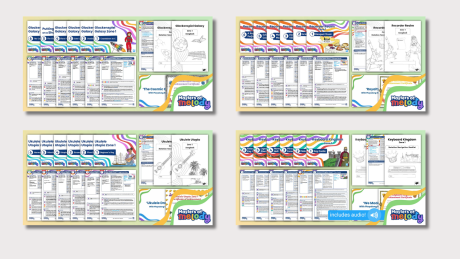 The four new Masters of Melody units offer a tried-and-tested expert-led roadmap to take beginners from their first notes to confident music-making. Twinkl’s National Education Lead for the Arts Karen Stretch finds out more.
Looking for a way to introduce whole-class instrumental sessions, but don’t know where to start?
Twinkl has launched four new dedicated instrumental units for recorder, keyboard, ukulele and glockenspiel, and each one takes absolute beginners from picking up the instrument for the first time to playing simple melodies and building confidence.
Created by music education experts, the units – included with the Masters of Melody curriculum scheme – are all tried and tested, and use the Melody Masters mascots – bird characters representing the interrelated dimensions of music such as pitch, tempo, rhythm and dynamics – to accompany young musicians on their journey.
As well as click-and-go planning and Powerpoints for each of the six sessions, the scheme includes a unit overview, a CPD video for teachers, skills video clips, a self-assessment pupil Notation Navigation Booklet and a songbook.
As Twinkl’s Music Education Content Lead Juliet Beane explains, each unit is based on a magical journey to engage learners in a fantastic new world.
“We have Glockenspiel Galaxy, Recorder Realm, Ukulele Utopia, and Keyboard Kingdom,” she says. “You have to complete tasks along the way so, for example, in Recorder Realm, you are performing a piece at a banquet. On market day you’re visiting the market and playing songs.”
In Glockenspiel Galaxy, learners take a journey in the Magical Musical Machine to be transported on an interstellar mission to a new galaxy in the year 2730. Ukulele players head off to Ukulele Utopia, a far away land where the Queen of the islands invites them to play for her celebrations in 1892. And in Keyboard Kingdom, players explore the kingdom before
heading back to Key Castle for a final ceremonial performance.
“We’ve thought about the fact that not every school has a whole set of classroom instruments,” says Beane. “So half the class can play while the others complete activities in the Notation Navigation Booklet. This is essentially a music theory booklet, looking at different elements that will help children to build confidence in learning music notation to support their journey.”
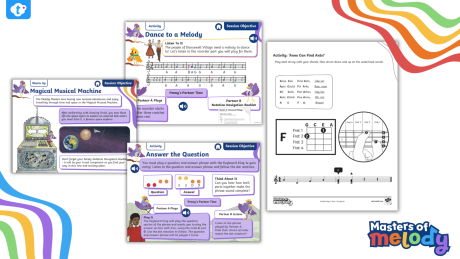
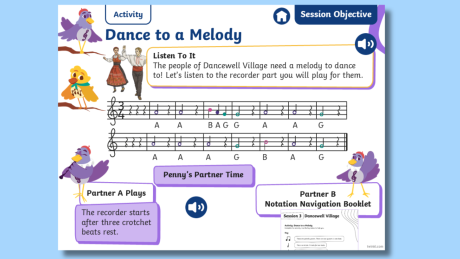 With a skills-based activity for each of the six lessons, teachers can ensure that pupils are occupied and learning as their partners use the instruments. There is also a composition section and a short self-assessment for each session, where children can easily log their achievements, and look forward to the next step of the course.
Rehearsal tools include a ukulele fretboard that can be printed and laminated so that children can practice putting their fingers on the right frets – especially useful if there are limited instruments available and children are taking it in turns. In the recorder unit, fingering is clearly taught, while keyboard and glockenspiel players follow carefully sequenced instructions, matching the keys to the note names and the music on the stave.
With colour-coded music notation throughout all four schemes, there is a focus on incremental learning of staff notation, following on from dot notation, graphic notation and stick notation.
This culminates in a performance piece at the end of the six sessions, where all of the skills learned are put into practice. With backing tracks for the children to play along with, there is the opportunity for a real showcase performance for the chosen audience of peers, whole school or parents and carers. There is even an achievement certificate for each scheme, which can be printed off and filled in with the pupil’s name, ready for presentation and celebration.
For teachers who are not musicians, or lack confidence to teach music, the instrumental schemes offer a chance to lead with well resourced and clearly explained lessons. In the overview for each instrument, there is a list of curriculum objectives, related to each session and showing how progression builds.
Resources are clearly linked and colour coded, with key vocabulary picked out in a glossary for each lesson ensuring that both teacher and pupil has full understanding of the musical language.
“We want the schemes to be as accessible as possible,” says Beane. “There are warm-ups, activities and checkpoints to audit learning on the hoof.”
 Suggested adaptations to each unit ensure that it can be flexible for all learners, with a dyslexia font version of the booklets included plus colour coding of the notes.
As Beane concludes:
“While there is scaffolding to help non-specialist teachers to teach with confidence – there is also a firm foundation from which experienced music teachers can help children to soar with their learning.”
To find out more about Twinkl’s Masters of Melody curriculum scheme, including the Instrumental Units, click here: Twinkl Masters of Melody
For further news updates from across the Music Education sector, visit our News page