Research Short: Accessible Digital Musical Instruments for Inclusive and Social Practices
23rd November 2026
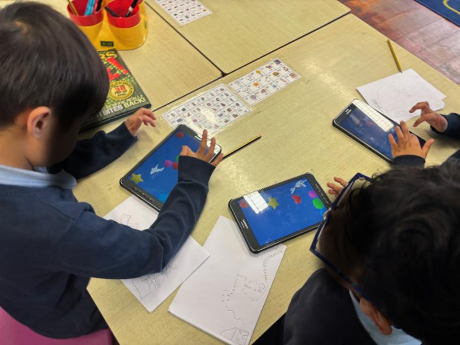 This week, I spoke to Dr Lee Cheng and Dr Chi Ying Lam about their recent project ‘Accessible digital musical instruments for inclusive and social practices’, in which they co-designed accessible digital musical instruments with a mixed-ability class of Year 1 primary school children.
In this project, they co-designed both a web app and a mobile app with participating children. They found that children like to use their body movements to make music (of course!) – but, more importantly, they found that digital interfaces can serve as extensions of their bodily actions rather than as externally operated tools. They also observed how their self-invented visual notations diverged from established forms of musical representation used in school contexts, suggesting ways of reducing barriers to musical engagement and learning.
The researchers conducted five monthly co-design workshops with a mixed-ability Year 1 class at a London primary school between October 2025 and March 2026. During these workshops, they guided the children in exploring the relationship between sound and bodily movement through co-design and music-making activities. They collected four sets of design worksheets completed by the participating children and analysed their design ideas alongside contextual data from the workshops, including the children’s spontaneous verbal explanations and reflective entries recorded by the two researchers. The resultant app recognises three specific gestures suggested by the participants: an open palm, a closed fist, and a raised index finger, each of which trigger a musical outcome, such as a dominant chord, tonic chord, or notes of a C major scale.
According to the researchers:
‘Some worksheet drawings and workshop discussions illustrated how children’s design ideas were shaped in relation to the physical and social environment of the classroom, including the drawing tools and visual artefacts used in the project. One example was a monster
character associated with a creepy sound upon interaction. The presence of the monster motif in workshop discussions and worksheet drawings suggests that it became part of the shared imaginative vocabulary of the workshops. The design process was also shaped by the physical constraints of the paper worksheets, the variety of drawing tools available, the social interactions within the classroom, and the anticipated features of the digital software.
These human and non-human elements interacted to guide and constrain the children’s creative choices.’
This research will be important for developers of music technologies and educational software to include children’s voices in the design process, responding more closely to their bodily movements, interests, and diverse abilities. Informed by the study’s findings, teachers can explore more inclusive approaches to musical engagement by incorporating gestures, visual prompts, and other child-friendly forms of musical representation, rather than relying exclusively on conventional notation and instrumental techniques.
This study is part of a publicly funded project to design accessible digital musical instruments for inclusive and social practices, supported by the ESRC Digital Good Network through the University of Sheffield (grant reference ES/X502352/1). Alongside working with school children, they interviewed stakeholders to evaluate the learning outcomes of this co-design initiative and integrated accessible digital musical instruments into school music therapy sessions as another part of the project.
Dr Lee Cheng is an Associate Professor at Anglia Ruskin University. His research interests include music technology, artificial intelligence, serious games, interactive design, and immersive media.
Dr Chi Ying Lam is a Lecturer in Community Music and Social Justice and Director of the Southampton Centre for Music Education and Social Justice. Her research explores community music, social justice, and the intersections of music, technology, and healthcare.
Written by Kerry Bunkhall – Research Manager for Music Mark
See the full list of Music Mark’s research