How Music Helps Us Explore Identity
3rd September 2026
AHRC Hub for Public Engagement for Music Research Showcase
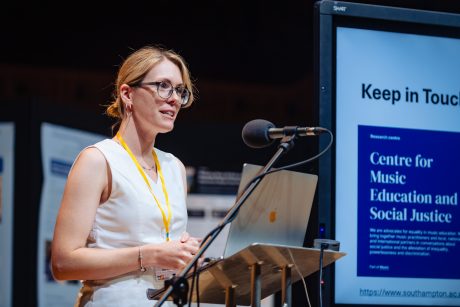 On 7th July, Music Mark’s Research & Data Manager, Dr Kerry Bunkhall, and Social Media & Content Officer, Ella Roberts, attended the AHRC Hub for Public Engagement with Music Research Showcase at Hoddinott Hall in Cardiff. Hosted by the Centre for Music Education and Social Justice at the University of Southampton, the hub ‘aims to connect music research to real world settings’, a feat which has certainly been achieved and is a testament to the expertise and commitment of the project teams and support provided by the department. Having been narrowed down through an extensive selection process from eighty-four applications to eight shortlisted projects, support and mentoring was embedded into the process which emphasised co-creation between academic and non-academic leads. University of Southampton’s policy specialists contributed their expertise, advising the project teams on how to translate their findings into policy briefings and engage with the next steps of change making.
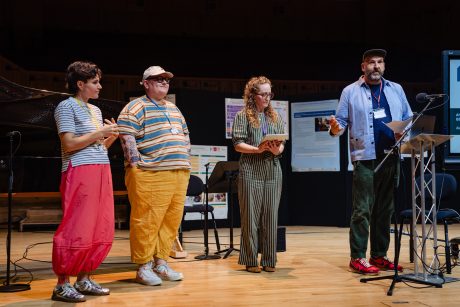 The first project to be spotlighted was ‘Musical Connections: Nurturing Musical Cultures in Autism Resource Bases Across the UK through Participatory Action Research’, led by the collaborative partnership of Dr Beth Pickard from University of South Wales and Alex Lupo from Live Music Now. The project emphasised the importance of a strength-based approach to music provision in specialist autism resource bases, explored through two 10-week musician-in-residence programmes in Wales and Northern Ireland. The project incorporated the children’s special interests and strived to put ‘neurodivergence at the centre rather than at the fringes’. In addition to the musical activities, the project leaders have created a series of policy documents for each devolved nation to guide their priorities and offer recommendations to improve the current offering.
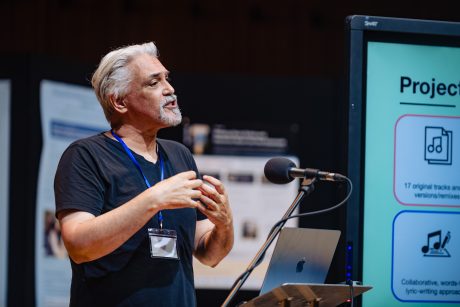 The second project, EQUALIZE, ‘began with an observation’ that Electronic and Black-British music is missing from secondary music despite it generating £24.5bn for the economy. The project leaders, Young Sounds UK and University of Westminster, focused on two aspects; the creation of a training model for teachers to ‘identify and nurture musical potential’, and policy recommendations to encourage change. Tested in Birmingham and Bradford through summer holiday programmes, the project was developed with the input of the original participants, who noted the importance of learning about the history and context behind the music, and championed the need for choice and autonomy in the classroom. Through a combination of lyric-writing, technical support and focussed planning, the learners created seventeen original tracks with fifty-two alternative versions/remixes. The research has also resulted in the creation of an interactive music map to show specific genres and their lineage to educate their students on the rich and active history, as well as future, of Black-British music.
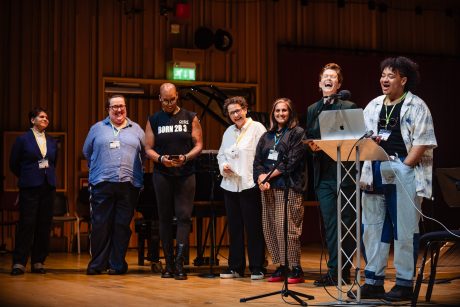 The third project featured at the event was ‘What Words do you Not Yet Have? Queer Musical Storytelling on Love, Life and the Law’, using storytelling to reframe the narrative away from the focus of oppression and legality, and towards affirming one’s own identity and experiences. A collaboration between SAYiT, an organisation which offers legal advice for those in the LGBTQ+ community, and University of Sheffield, the project explores all facets of love; self-love, friendship, family, community and romantic love. Undertaken through two two-day residential workshops, participants were encouraged to take control of their own stories through musical creation, performance and editing.
The showcase highlighted a number of interconnecting themes, namely taking a strength-based approach to involve underserved demographics, the need for autonomy, and encouraging exploration rather than mastery. If anything can be taken from the efforts and dedication of these teams and their participants, it is the need for music to act as a vehicle for self-expression, self-exploration and self-identity. Represented both in person and on screen, the participants espoused how music helped them to explore their own sense of identity and their uniqueness. In a time of increasing technological intervention, AI, global uncertainty and a record-breaking heatwave, this session offered a reminder that music can channel what it is to be human, and it is through allowing for autonomy and individuality that this is possible.
For further news updates from across the Music Education sector, visit our News page