How Child-led Play Shapes Early Years Music
15th September 2026
Magic Acorns is a child-centred early years arts organisation that creates spaces where babies, young children, families, and artists can explore music through imaginative play.
We chatted with co-Director Sophie Fox and Director and Creative Researcher Dr Jessica Pitt about how Magic Acorns’ child-led approach to musical play supports connection, curiosity and inclusive early years practice, ahead of their session at the Music Mark Conference 2026.
Musical play sits at the heart of Magic Acorns’ work. What are some of the key benefits you’ve observed when children are given the freedom to explore music through open-ended play?
Open-ended musical play allows children to explore, take risks, and follow their ideas for as long as needed. Our learning from following children’s interests has shown us that when children see a space as safe for exploration they can relax, explore and wallow with sound makers. This also builds their confidence and self-esteem, helping children to trust their impulses and value their ideas. It broadens the definition of music beyond instrument mastery, reading, or pre-existing songs, recognising sound play as expressive music-making. Children are seen as capable music makers, engaging in individual or layered, group sounds that develop their own form. This might look and sound chaotic and messy – just like much of children’s play when viewed from the outside.
Your approach encourages adults to observe, wait and listen before intervening. Why is this such a powerful strategy, and what can music educators learn from slowing down and tuning into children’s musical responses?
We have found that creating space for unhurried moments and a slow approach has allowed us to realise that children under five have no sense of clock time. They operate in a totally different time frame. Things take the time they take. In many settings, silence can feel uncomfortable for adults, often leading to us filling the silence with adult sounds. “Observe, wait, listen” interrupts this, allowing children, especially those under 3, to fill silence with their own vocalisations, sounds, and responses. This approach shifts the adult’s role from leading to noticing, sensing, and listening; adults can respond to what a child is expressing in that moment, rather than steering them towards a predetermined answer.
Many music education settings work towards defined outcomes, but your work starts with children’s curiosity and interests. How does this shift in perspective change the musical experience for both learners and educators?
It can feel risky because a responsive approach may not lend itself to the typical focus on measurable outcomes and planned progression. However, this focus has revealed to us more than we expected, as children display musical competence, creativity, and engagement that might not have surfaced through structured activities. It redefines early-years music as something “caught not taught,” making observation and reflection an integral part of teaching rather than just preparation. We have found that it changes the dynamic towards co-creation and collaboration. Adults can join children as fellow music makers rather than just authority figures, while still supporting the development of technical skills alongside expressive and creative music-making.
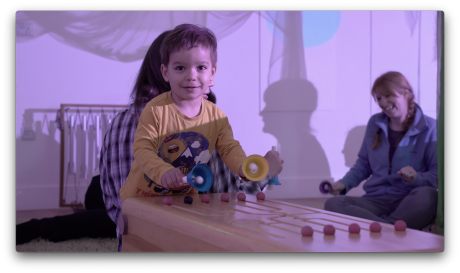 What might surprise educators about what children can achieve musically when they are given space to lead, experiment and play without fear of getting things ‘wrong’?
We have been surprised by the richly inventive ways children express themselves, showing confidence, courage, and an ability to produce richly textured sound when they feel free from the fear of making mistakes. Early experiences in ‘performing’ in front of peers with the expectation that one must be ‘good enough’ can inadvertently convey what can become a lifelong held belief about oneself as musical, or not. Therefore, creating supportive spaces where experimentation is encouraged matters not just for immediate musical activities, but also for fostering our long-term musical confidence and sense of identity.
For Music Mark members looking to create more inclusive and responsive learning environments, what practical lessons from the Magic Acorns approach could they start applying in their own settings straight away?
Begin by viewing your environment as musical. No special equipment or space is needed; the key is to recognise the musical potential in everyday sounds, objects, movements, and interactions. Try ‘observe, wait, listen’ to encourage patience and attentiveness, experiment with allowing silence, try to resist the urge to fill the space or act too quickly. Notice what arises, resist the urge to control it, and then engage by joining in or simply listening.
Valuing the process as much as the outcome is vital. Regular music-making can foster a community of musicians and create something meaningful, regardless of performance. Music is relational: it’s about connection, communication, and shared experience, and it often conveys what words cannot. Finally, when working in an early years setting build on the expertise in the room. Early-years practitioners know their children and about creating play environments, while music educators bring sound discernment and where the music is to be found in children’s play. The most effective partnerships occur when all the expertise is shared and together you keep asking questions
Don’t miss your chance to join the Magic Acorns session, as well as many more inspirational talks at the Music Mark Conference 2026 on the 16th and 17th November, in Liverpool. The full programme is available to explore here, and don’t forget to book your tickets now!