How Can Students Build Rhythm Confidently?
17th August 2026
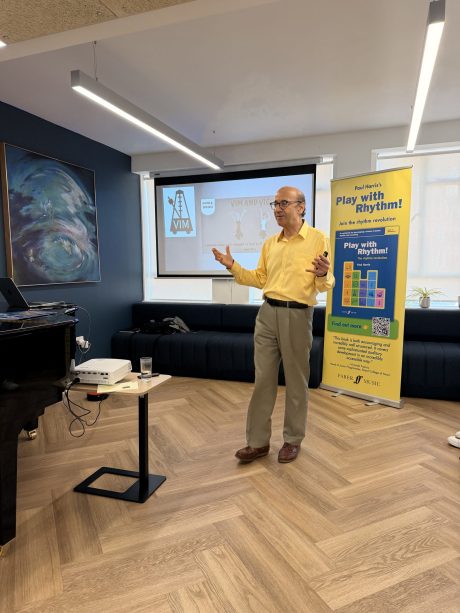 Rhythm can be one of the trickiest things for students to feel confident about, but it doesn’t have to stay that way. ‘Play With Rhythm!’ Paul Harris’s new book, offers teachers a practical, encouraging way to help students internalise pulse, understand how rhythm works, and build trust in their own sense of timing.
Miranda Francis, Head of Junior Programmes at the Royal College of Music, describes the book as “encouraging and incredibly well structured,” highlighting how it makes sophisticated auditory development accessible for students and teachers.
Start by Naming the Real Problem
For many teachers, the challenge is familiar: how do you help students move beyond mechanical counting and towards a rhythm confidence that feels secure, expressive and genuinely musical?
Subtitled The Rhythm Revolution, ‘Play With Rhythm!‘ offers a fresh, practical response to that question. The book explores two common teaching habits that can make rhythm feel less secure for learners. One is relying on explanations that are technically accurate but hard to translate into practice; the other is showing students ‘how it goes’ without helping them understand why it goes that way. By addressing both, ‘Play With Rhythm!‘ helps teachers move students toward accuracy rooted in real understanding.
Move Through the Four Stages of Learning
At the heart of ‘Play With Rhythm!‘ is a four-stage learning model that reframes confidence as something students gradually grow into rather than something they either have or don’t have:
1. Don’t know / can’t do it
2. Liminal space – the uncertain in-between stage
3. Know it / can do it
4. “I know that I know” – true, internalised confidence
This framework matters because it shows students (and teachers) that hesitation and uncertainty are a normal, necessary stage – not a sign of failure – on the way to secure understanding.
Develop an Internal Sense of Pulse with VIM
One of the book’s most practical tools is VIM, the Virtual Internal Metronome, which helps students develop a steady inner pulse they can rely on. It begins with the simple idea of subdivision – a bigger unit divided into smaller units, in the same way an hour is made up of 60 minutes. Students don’t need to start with the terminology; they only need to feel how a larger pulse can break down into smaller, even parts. From there, layered subdivision gives them a more detailed internal grid to work from.
The name VIM also brings a little character to the method. It nods both to Vim, the cleaning product long associated with being effective and enduring, and to the phrase ‘vim and vigour’ – a reminder that rhythm should feel alive, energetic and musical, not dry or mechanical.
VIM helps students build a genuine internal sense of pulse rather than counting externally:
- Read through the music and identify its ingredients
- Sense the VIM internally
- Know the rhythm will be accurate
- Clap or play with certainty
By working through this sequence every time, students learn to trust their internal pulse before they ever attempt the rhythm out loud – which is where real confidence comes from.
Understand Rhythm as Movement, Not Just Duration
‘Play With Rhythm!’ also reframes rhythm more broadly as movement rather than a set of durations to be counted. Four elements create this sense of movement:
- Emphasis
- Flow
- Energy
- Punctuation
Within this model, note length isn’t simply ‘how long a note lasts’ – it’s an indication of when to start the next note. This shift in thinking helps students play rhythms expressively and instinctively, rather than mechanically counting beats in isolation.
Find out more
Paul Harris is hosting an online webinar exploring the ideas behind ‘Play With Rhythm!’
The webinar will touch on different teaching techniques such as: the virtual internal metronome, layered subdivision, and the practical application of rhythm. Through demonstrations, insights, and interactive activities, Paul will show how strengthening this internal sense of pulse can transform both practice and performance.
Ideal for teachers of students of all levels, this webinar offers a unique opportunity to learn directly from Paul Harris and discover effective strategies for making rhythm engaging, accessible, and enjoyable. Whether you’re looking to enhance your teaching or deepen your own musicianship, this session will provide practical ideas and fresh inspiration to take your rhythmic skills to the next level.
Attend the Online Launch on 2nd September
For further news updates from across the Music Education sector, visit our News page